Egyptian Faience
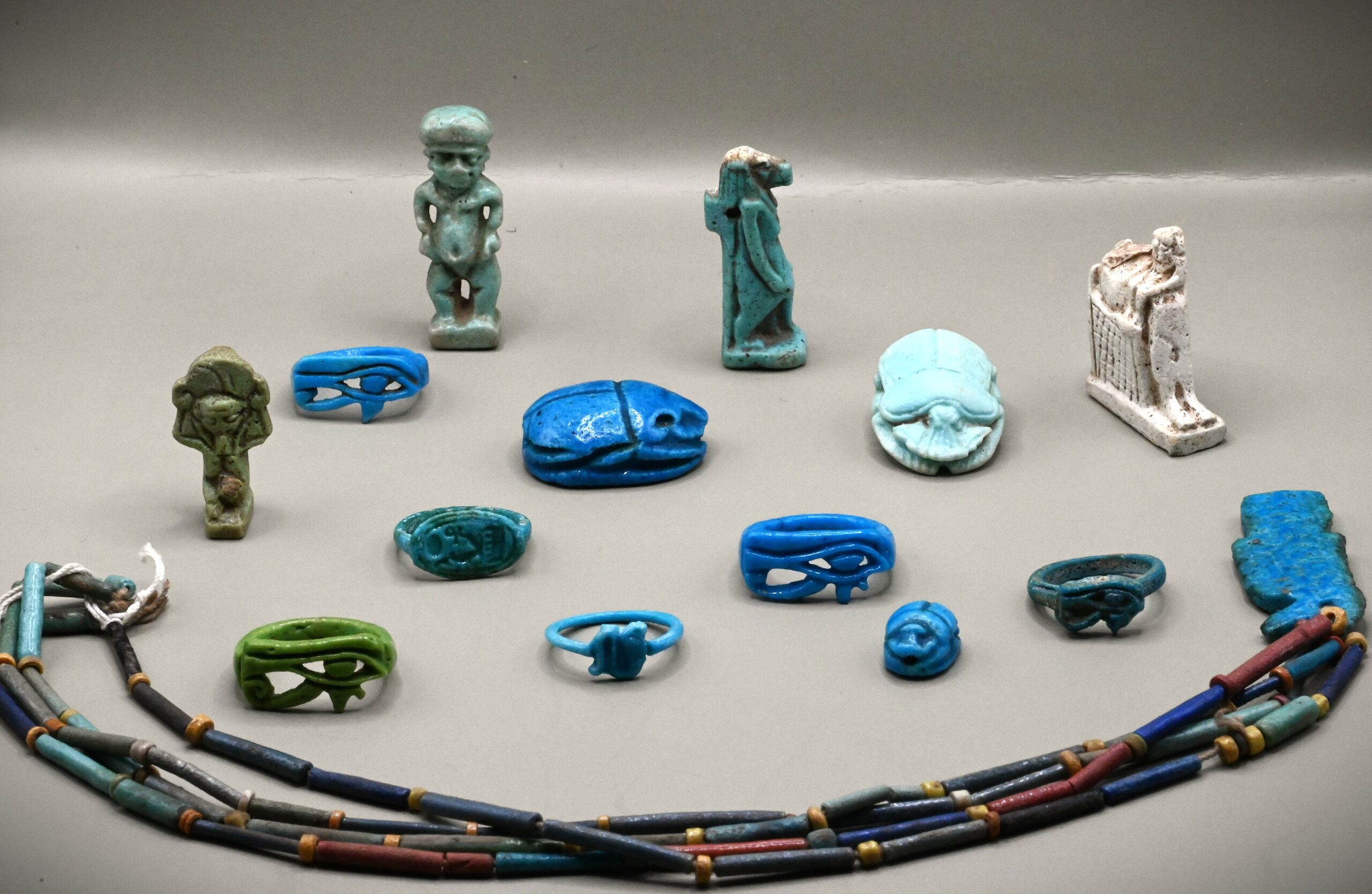
Egyptian faience comes in all sorts of shapes and colours. Although blue is the most common colour, faience was produced in a wide range of colours.
Ancient Egyptians called faience ’tjehnet’. It can be translated as dazzling, sparkling or glossy. It is often regarded as a precursor to glass, not only because the upper layer has a similar shine, but primarily because it is made of the same three main materials: Silica (around 80-95%), Lime (1-6%) and Alkali (0,5-3%).
Quartz pebbles or quartz-rich sand were crushed, ground and mixed with the other main materials. After adding water, the paste could be modeled by hand or pressed into a mould. The objects were then glazed and fired in kilns that could reach temperatures of around 1000 degrees Celsius.
Egyptians used various glazing techniques. The application technique was the most common. Three main ingredients were mixed with water and colouring materials until they formed a liquid paste. This paste was then either added by painting it onto the object or dipping the object into the paste before firing. For colouring, small amounts of metal oxides were added to the paste. For example, copper oxide or cobalt for blue, iron oxide for brown, lead antimonite for yellow and manganese for purple. Objects glazed using this technique can often be recognised by drip marks, small unglazed areas where it rested in the kiln, or a relatively thick glaze. Other glazing techniques were efflorescence and cementation.
The faience objects shown here were usually made using the application technique.