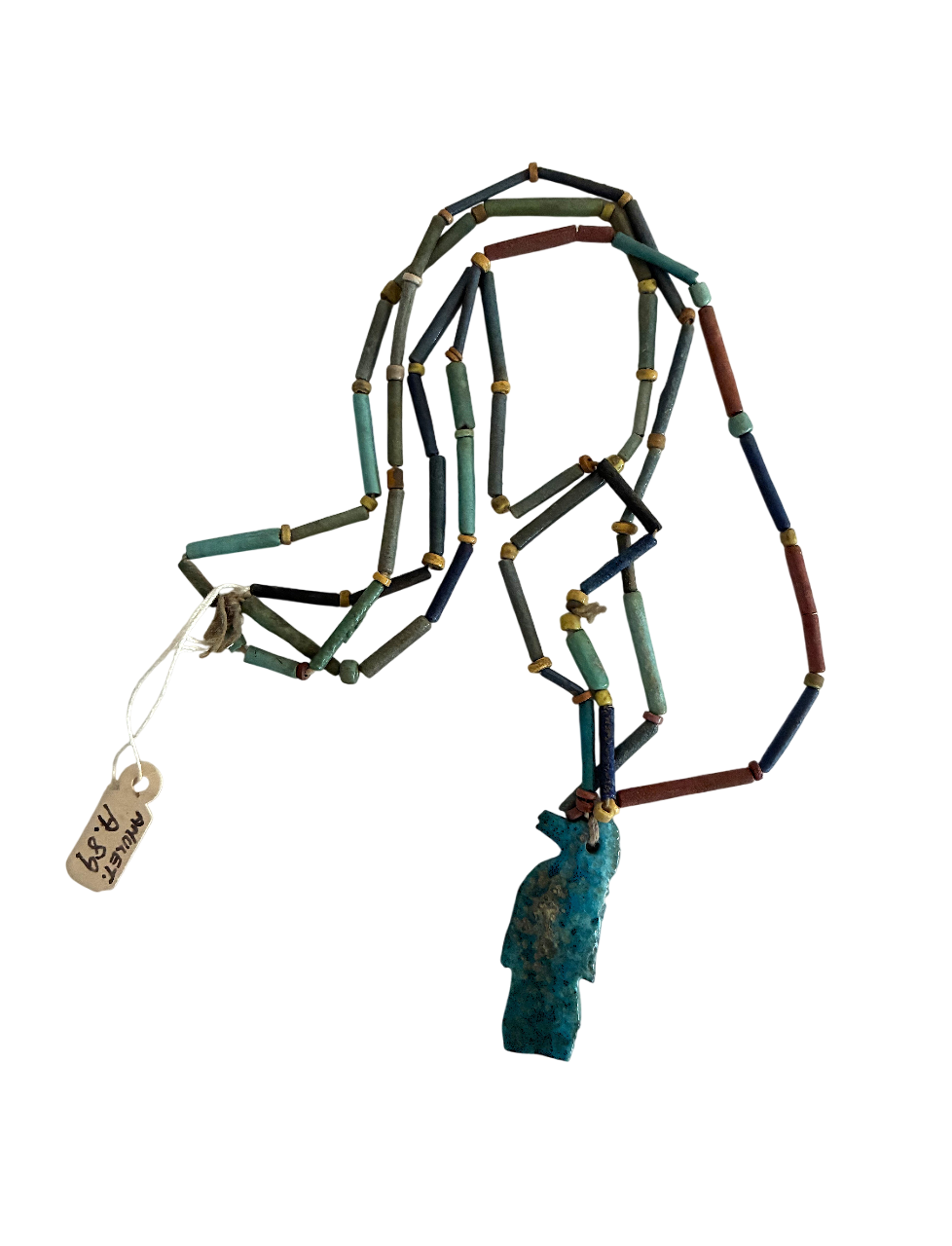
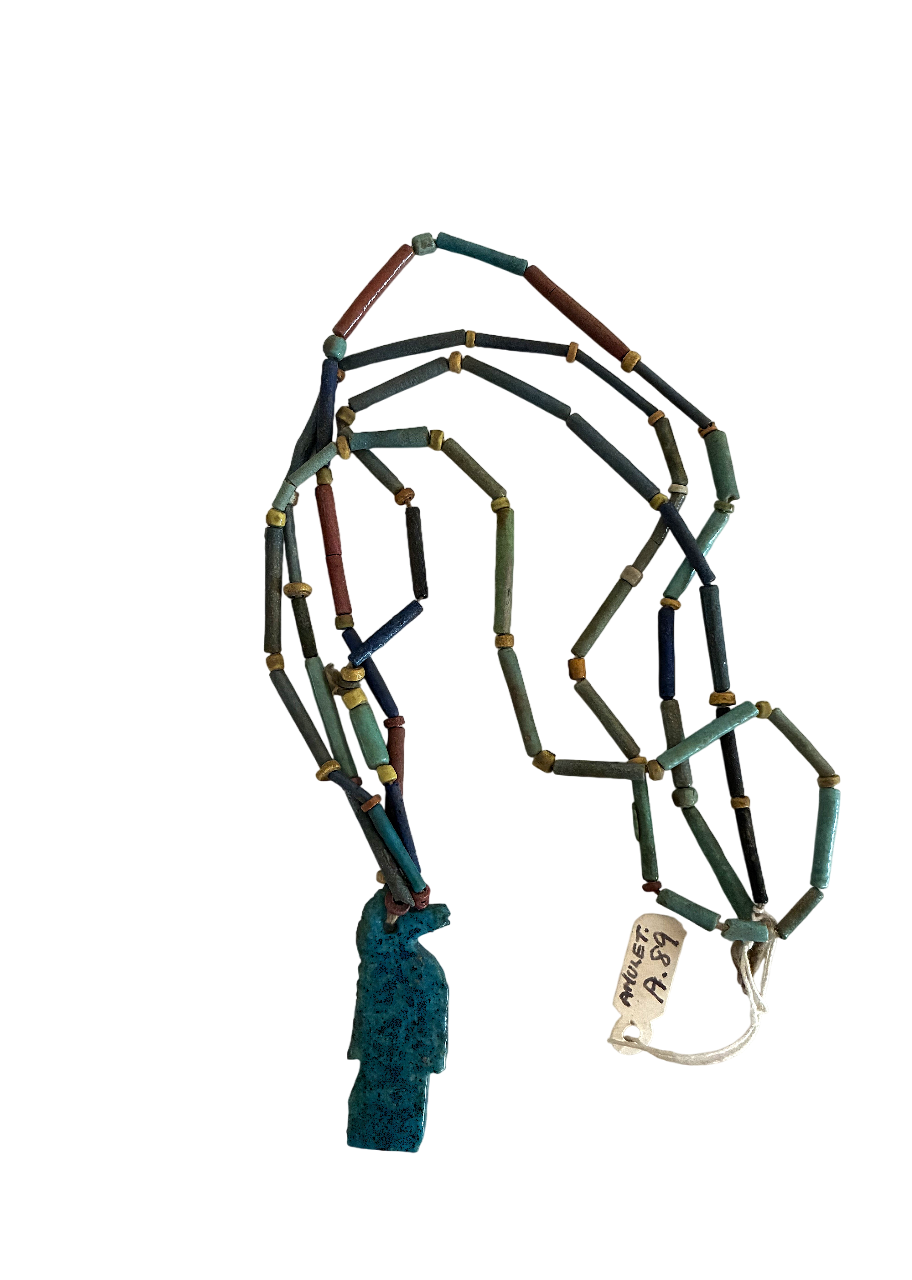
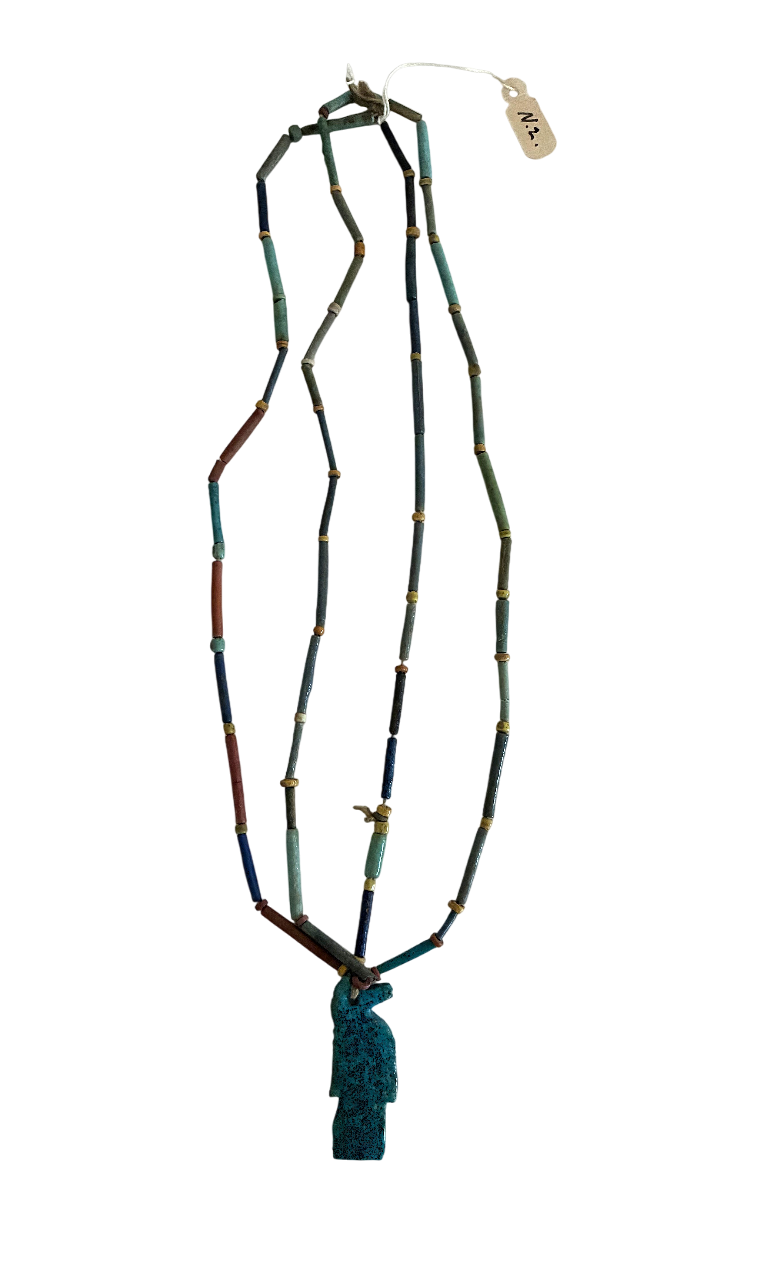
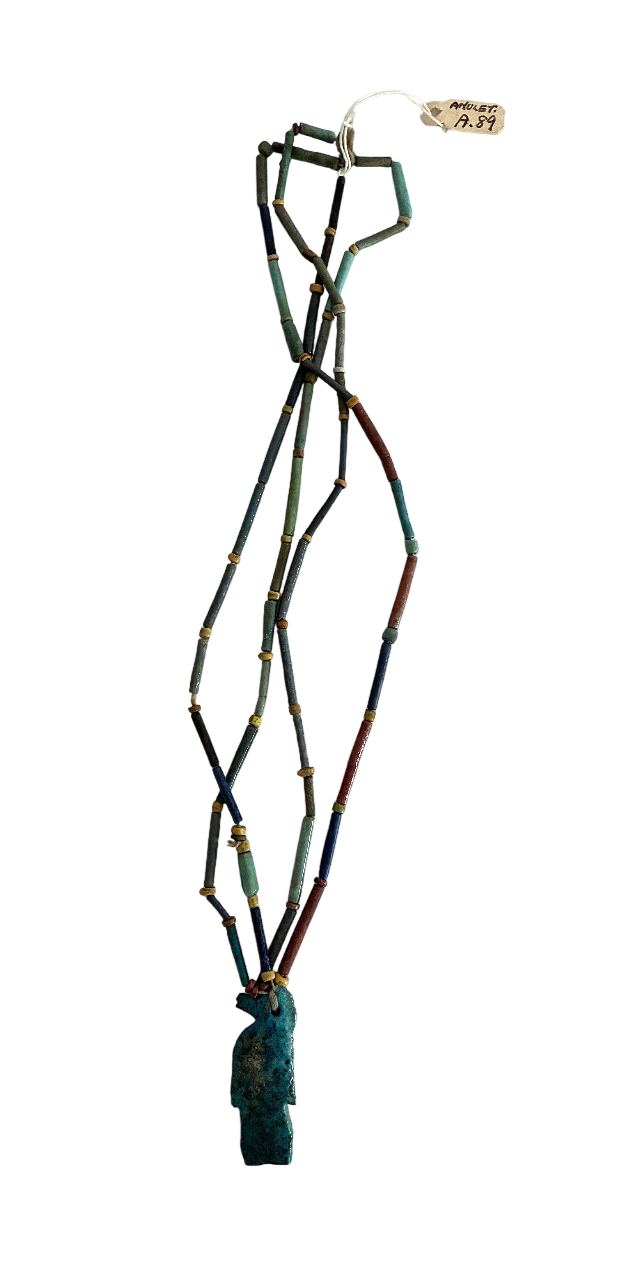
Colorful faience necklace with Son of Horus pendant
Price
€ 760
Description
A colorful faience necklace with a blue faience Son of Horus plaque pendant, most likely representing Duamutef. Four different strings of faience beads alternate between long cylindrical types and small circular beads. The cylindrical beads differ greatly in color, ranging from light blue and grey to green, red and dark blue. The small circular beads are mostly yellow, with a handful of red.
Beads were the most common use of faience. They were made in many shapes: spherical, tubular, discoid, barrel-shaped, or even tiny amulets (lotus, eye, frog, etc.) that could be strung together.
They were worn as necklaces, bracelets, anklets, girdles, sewn onto clothing, or attached to hair and wigs. Larger faience beads were used in elaborate collars (wesekh).
The Sons of Horus were an important group of four protective deities in ancient Egyptian religion, most famous for their role in mummification and the afterlife. The Sons of Horus were thought to guard the viscera (liver, lungs, stomach and intestines) removed during mummification. Each organ was placed in a canopic jar topped with one of their heads. The sons were: Imsety (human head), Hapy (Baboon-head), Duamutef (jackal-head) and Qebehsenuef (Falcon-head).
Culture
Egyptian
Dating
c. 1500 - 1200 B.C.
Size
Each string of beads (4 in total) is c. 24 cm long. The pendant is 4 cm long. In total c. 28 cm long.
Provenance
Dutch private collection, bought from Bonhams London.
Walter Thomas Gaze Cooper (1895-1981) collection; and thence by decent to the previous owner.
From the Myers Collection (Major William Joseph Myers) (1858-1899), including old note.
Condition
Well preserved colors, restrung, pendant bottom part broken. With old inventory label attached.